Sub-Zero Built-In Warm on the Food Side, Nocatee
Two refrigeration circuits in one cabinet, a condenser working against Florida heat, and a door heavy enough to change its own geometry.
A built-in is not a freestanding refrigerator in a nicer cabinet. It is fitted into a specific opening, it rejects its heat forward through a grille instead of out of the back, its door often carries a panel it was not balanced for, and it runs two independent refrigeration circuits rather than one. Every one of those differences shows up in how it fails.
Which half is failing
Separate circuits for the fresh food and freezer compartments make the first question easy to answer. A freezer holding at setpoint while the fresh food side climbs points at one circuit, not at the cabinet. Both compartments warming at once points instead at something they share — power, control, or a condenser choked for both.
That distinction is worth money. An estimate written for one sealed system is not an estimate for two, and we will not present it as one. It is also the reason stage 4 of our sequence logs both compartments across the visit rather than reading a display once: the pattern over an hour is the diagnosis, and a single number is not.
Condenser first, always
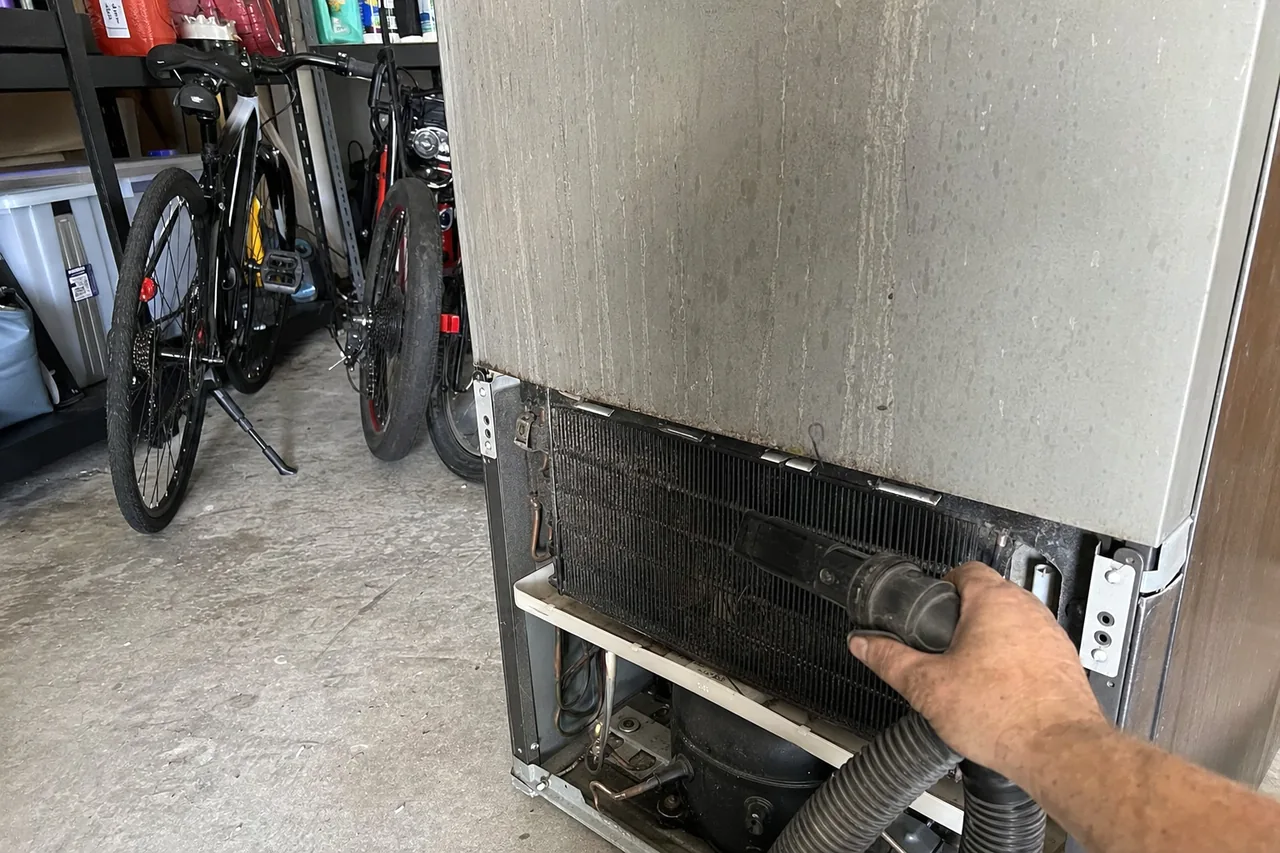
Before anything is opened, the condenser gets read. Built-ins here run their coils against high ambient heat for eight months of the year, and a coil packed with dust and pet hair adds head pressure to a system that is already working. A restricted condenser produces precisely the complaint list owners describe as a failing compressor: long run times, poor recovery, a warm cabinet and more noise than there used to be.
The clearance around the cabinet is part of the same check. A filler panel added during a later kitchen refit, trim closing the gap above a full-height unit, or storage packed into the service gap behind it all reduce heat rejection without anything visibly changing at the front. None of that can be fixed by replacing a part, and all of it will make a healthy sealed system measure badly.
The door is a refrigeration component
A vacuum-tight door that will not reseal immediately after being opened is normal — the cabinet is equalizing pressure. A door that has stopped pulling flush over its final inch is not. The seal breaks at the top corner, humid Florida air enters, duty cycle rises, and frost appears on the back wall of the freezer weeks before anyone connects the two events.
We put a straightedge on the door and check seal contact along its full length on every visit, because a door adjustment presented as a refrigeration fault is the most expensive mistake available in this trade.
Water in the base is usually a drain
Water pooling under a crisper, or freezing into a sheet at the bottom of a compartment, is nearly always a restricted defrost drain rather than a leak. The evaporator sheds condensate into a path that ends in a pan near the compressor, where the compressor’s own heat evaporates it away. Restrict that path with debris, with ice, or with the sludge that builds up in a cabinet handling humid air, and the water backs up to the lowest point you can see.
Storms and boards
Around 68 thunderstorm days a year cross this part of north-east Florida. What they damage is control electronics, not compressors — and the multi-day outages that came with Matthew in 2016, Irma in 2017 and Helene in 2024 left a delayed version of the same signature, with boards failing weeks after the power came back. A cabinet that went dark during an August afternoon and a cabinet that has been slowly losing ground since spring are different investigations, and they should never appear on the same estimate line.
Is there a reset on a Sub-Zero refrigerator?
There is no single reset button across this equipment, and an instruction that promises one is describing somebody else’s cabinet. What there is, on most units, is a control panel that can be taken through its own power cycle and, behind the kitchen wall, a dedicated breaker. Dropping supply at that breaker for a few minutes and restoring it is the whole of what a reset means here.
It is also stage 1 of the sequence rather than a trick, because of what the result tells you. A cabinet that comes back and stays back had a control event. A cabinet that comes back and drifts warm again has something the control was never going to fix, and the next reset will tell you nothing you did not already know.
That is the honest answer to a unit that has not cooled properly since an outage, too. One that went dark in a storm and returned on its own is one story; one that has never been right since is usually a board rather than refrigeration — and quoting a board as refrigeration is the expensive mistake this page keeps coming back to.
What we do on a diagnostic visit
The $80 visit is a measurement, not a guess. Supply and controls, condenser and clearance, door and seal, temperatures logged against setpoint, fill and dispense volumes if the cabinet is plumbed, and the sealed system last. You get a written estimate before any part is ordered and before any work starts.
Sealed-system work — opening, recovering from and recharging a refrigeration circuit — requires EPA Section 608 certification, which our technicians hold. That is a legal requirement for handling refrigerant, and it is the only certification claim on this site.
Nocatee’s housing stock is almost entirely 2007 onward. The first phase of built-ins here is now old enough that original sealed-system coverage has run out on many units, which changes the arithmetic on a repair-or-replace decision. Because a built-in is fitted to its opening, replacing one is joinery as well as appliance work — so the comparison is rarely as simple as the showroom price suggests. We put both numbers in the estimate.
What does built-in refrigeration work cost in Nocatee?
$80 flat to diagnose, credited toward the repair once you approve it. Completed work on this page has landed between $240 and $2,270, parts and labor together. The firm figure is written down after the diagnosis, not before it.
| Repair | Typical range |
|---|---|
| Diagnostic visit, credited toward the repair | $80 |
| Evaporator or condenser fan motor | $260–$570 |
| Compressor or sealed-system repair | $910–$2,270 |
| Ice maker, water valve or supply line | $240–$650 |
| Defrost heater, thermostat or sensor | $250–$590 |
Ranges are what this work has cost, not a quote. A range moves with the part version the serial number calls for and with what the cabinet turns out to need. The whole table is on the pricing page.
How much does built-in refrigeration work cost in Nocatee?
$80 flat to diagnose, credited toward the work. Completed repairs in this category have run $240 to $2,270, parts and labor together. The band your cabinet lands in is written into the estimate before anything is ordered.
Is the $80 charged on top of the repair?
No. Credited toward the repair if you go ahead with the work. It covers the visit and all 6 stages, whichever stage the fault turns out to sit at, and there is no separate call-out charge and no hourly rate running beside it.
Which repair on this list is the expensive one?
The sealed system, at $910–$2,270 against $250–$590 for a door gasket. It is measured last for exactly that reason: the five cheaper stages can each make a healthy circuit read badly, and most of what they find is an adjustment rather than a part.
$80 flat to diagnose, credited toward the repair if you go ahead with the work. 90 days on labor, 365 days on parts. Pricing · Warranty · Contact
Calls about built-in refrigeration, as owners described them
Three of the Sub-Zero owners who called us, picked because the call was about this equipment.
4.64.6 out of 5 — the mean of all 60 reviews collected after a visit
4 out of 5
The unit is original to the house and I assumed we were shopping for a replacement. He was straight about what the cabinet has left in it, fixed the evaporator fan motor that had seized, and told me what to watch rather than upsell.
Nadia F.September 2025
4 out of 5
The cabinet was cycling almost constantly and the kitchen was loud at night. He put a straightedge on the door seal first, found the top corner standing off, adjusted the hinge, and the run time settled inside a day.
Janelle O.January 2026
5 out of 5
He walked me through what each stage had ruled out as he went, so by the time he named the fault I already understood why it was the only thing left. Very few trades bother to do that.
Ravi S.May 2026