The diagnostic sequence
Six stages, run in the same order on every visit. The cheap ones come first because they are the ones that most often explain the symptom.
Every visit begins with the same two questions, asked before anyone touches the cabinet: what is the appliance doing, in your words rather than in a diagnosis, and what has changed since it last behaved properly. Then the model and serial number come off the rating plate, because the serial is what decides which version of a part actually fits.
After that the sequence runs. It is not a checklist for its own sake — the order is the argument. Each stage is cheaper and less invasive than the one after it, and each stage removes a way the next reading could be misinterpreted. A sealed-system measurement taken behind a blocked condenser or a door that is not sealing is not merely unhelpful; it describes the obstruction rather than the machine.
- Power and controls Stage 1 A meter and a question. No panel comes off.
A dark or unresponsive cabinet is a power or control investigation, not a refrigeration one. Quoting it as refrigeration is the most expensive mistake available on a first visit.
- Air and clearance Stage 2 A grille off and a light. Ten minutes.
A restricted condenser produces the entire complaint list of a failing compressor — long runs, poor recovery, a warm cabinet, more noise. It is the cheapest fault on the list and the most commonly missed.
- Door and seal Stage 3 A straightedge, a torch and a sheet of paper.
Frost on the back wall, condensation at a panel edge and a duty cycle that never ends are all produced by a door that has stopped pulling flush. That is an adjustment, not a repair, and it should never reach a refrigeration estimate.
- Temperature and defrost Stage 4 Logged temperatures, and the patience to wait out a cycle.
Frost on one section of an evaporator with clear metal on the rest is a charge or restriction pattern. Uniform heavy frost that clears when the cabinet is emptied and left open is usually defrost. They need different parts and different money, and only a measurement separates them.
- Fill and dispense Stage 5 A graduated vessel and a stopwatch.
If ice and dispensed water weaken together, the restriction sits upstream of the point where the line splits. If only one side weakens, it sits downstream. That single comparison halves the investigation before a part is touched.
- Sealed system Stage 6 Gauges, a recovery machine and EPA Section 608 certification.
Nothing. This stage is last because everything cheaper has already been eliminated, and because it is the only stage that legally requires EPA Section 608 certification to carry out.
Bar length is how far into the cabinet each stage reaches, on the same axis the sequence bar uses elsewhere on this site. Stage 5 applies only to units with a water connection.
The stages
- 1 · Power and controls A meter and a question. No panel comes off.
- 2 · Air and clearance A grille off and a light. Ten minutes.
- 3 · Door and seal A straightedge, a torch and a sheet of paper.
- 4 · Temperature and defrost Logged temperatures, and the patience to wait out a cycle.
- 5 · Fill and dispense A graduated vessel and a stopwatch.
- 6 · Sealed system Gauges, a recovery machine and EPA Section 608 certification.
What the sequence does not do
It does not decide the price before the measurements exist. The visit is $80 flat regardless of how many stages it takes to reach the answer, and credited toward the repair if you go ahead with the work. You are told what each stage ruled out, not only what the last one found — which is the difference between a diagnosis and a guess with an invoice attached.
Stage 5 applies only to units with a water connection. A wine cabinet or a refrigerator column with no dispenser and no ice maker skips it, and any diagnosis that blames the water side on such a unit is wrong before it starts.
What does the repair at the end of the sequence cost in Nocatee?
$80 flat to diagnose, credited toward the repair once you approve it. Completed work on this page has landed between $240 and $2,270, parts and labor together. The firm figure is written down after the diagnosis, not before it.
| Repair | Typical range |
|---|---|
| Diagnostic visit, credited toward the repair | $80 |
| Door gasket or seal replacement | $250–$590 |
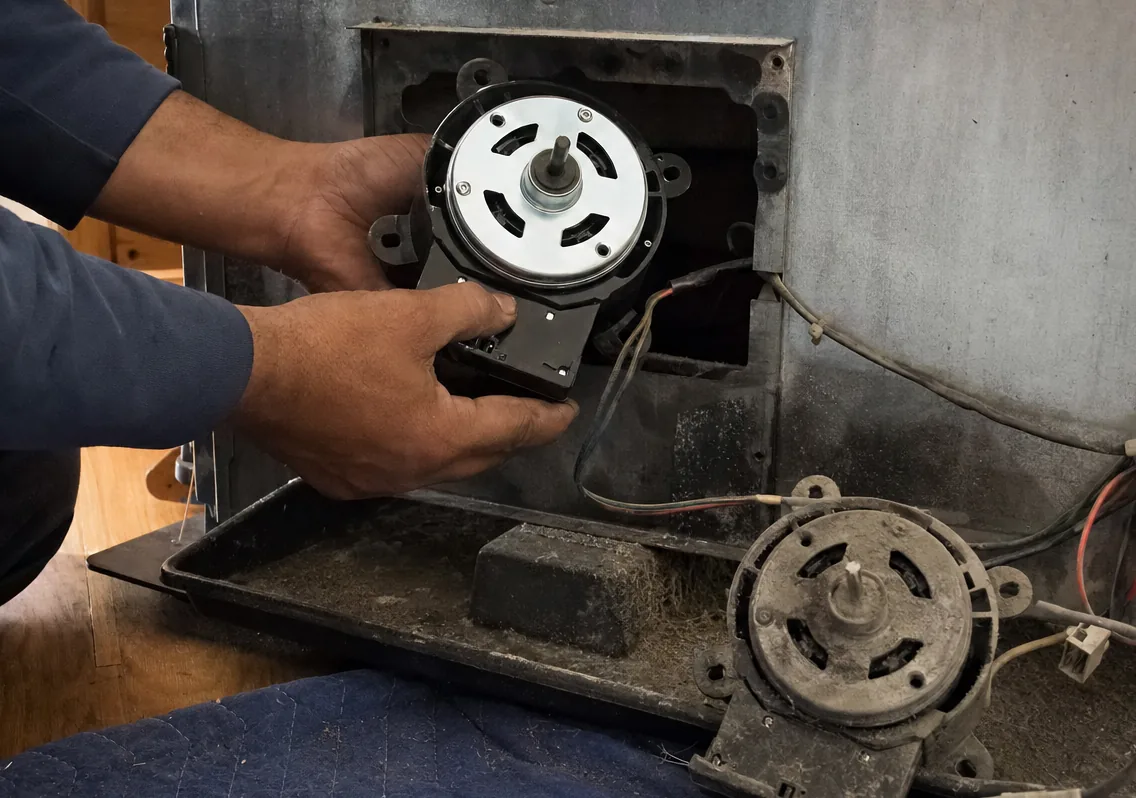
| Evaporator or condenser fan motor | $260–$570 |
| Defrost heater, thermostat or sensor | $250–$590 |
| Ice maker, water valve or supply line | $240–$650 |
| Electronic control board | $420–$780 |
| Compressor or sealed-system repair | $910–$2,270 |
Ranges are what this work has cost, not a quote. A range moves with the part version the serial number calls for and with what the cabinet turns out to need. The whole table is on the pricing page.
How much does the repair a stage points at cost in Nocatee?
$80 flat to diagnose, credited toward the work. Completed repairs in this category have run $240 to $2,270, parts and labor together. The band your cabinet lands in is written into the estimate before anything is ordered.
When is the cabinet not worth repairing?
When the part is discontinued, when the lead time is longer than you can live with, or when the figure is a large fraction of a replacement. A sealed-system repair runs $910–$2,270, and the estimate says plainly when that is the wrong side of the comparison.
Is the $80 charged on top of the repair?
No. Credited toward the repair if you go ahead with the work. It covers the visit and all 6 stages, whichever stage the fault turns out to sit at, and there is no separate call-out charge and no hourly rate running beside it.