Stage 6: The Sealed System, and What It Costs
Last, because everything cheaper has already been eliminated — and because it is the only stage that legally requires EPA Section 608 certification.
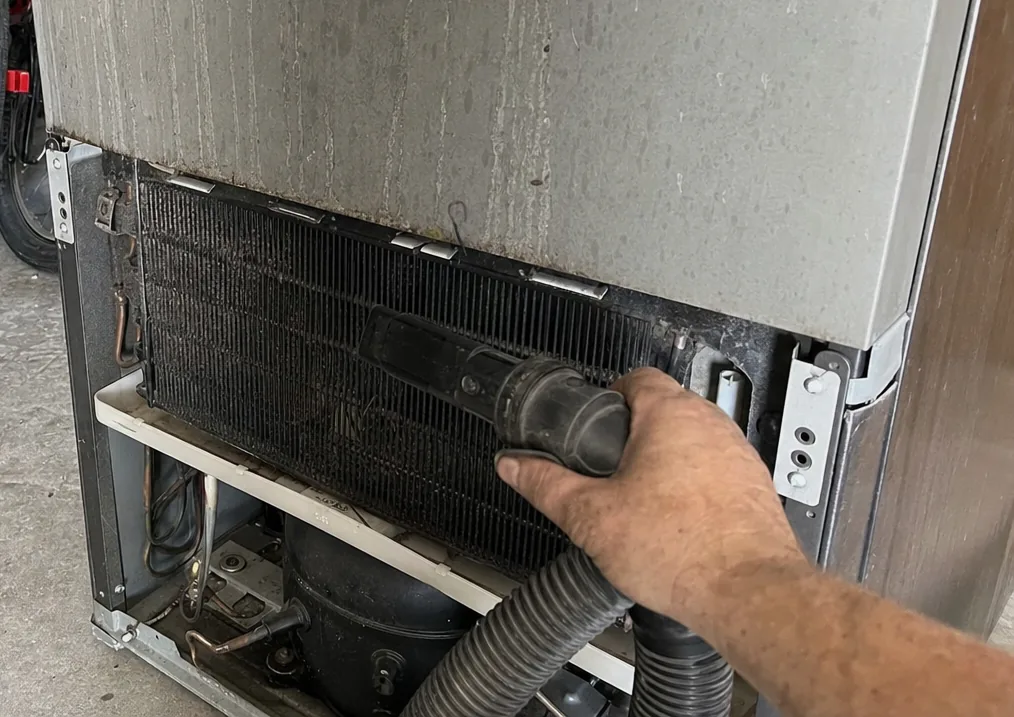
The sealed system is the compressor, the condenser, the evaporator, the metering device and the refrigerant that moves between them. It is the most expensive thing in the cabinet and the least likely explanation for the symptom you called about — which is exactly why it is measured last.
What “last” buys you
By the time this stage begins, five things are already known: the cabinet has power and its controls behave; it can reject its heat through a clean condenser with real clearance around it; its doors are sealing along their full length; it has been logged against setpoint through a cycle and its evaporator frost pattern has been read; and, if it is plumbed, its fill and dispense volumes have been measured.
Every one of those is a way a healthy sealed system can be made to look sick. A compressor working against a blanketed condenser produces high readings that mean nothing about the compressor. A cabinet drawing humid air through a door corner produces a duty cycle that looks like lost capacity. Removing those first is not thoroughness for its own sake; it is the only way the readings taken here can be trusted.
What gets measured
Temperatures across the circuit, taken at points that describe what the refrigerant is actually doing rather than what the cabinet says it is doing. Physical evidence of loss — oil at a joint, staining on tubing behind the grille, because refrigerant that leaves usually takes a little oil with it. Compressor and inverter behaviour under load, since a compressor that starts, runs and produces no useful capacity is a different fault from one that will not start at all.
Frost on one section of an evaporator with clear metal elsewhere, noted back at stage four, usually points here: a charge or restriction pattern rather than a defrost fault.
Refrigerant work is regulated
Opening, recovering from and recharging a refrigeration circuit requires EPA Section 608 certification under federal law. Our technicians hold it, and it is the only certification claim on this site. It is a legal requirement for handling refrigerant, and it is not a manufacturer endorsement of any kind.
Anyone who offers to “top up” a sealed system without recovering, repairing and recharging it is describing something that is both bad practice and, done in the open, illegal. A sealed system does not consume refrigerant. If it is low, it has a leak, and the leak is the repair.
Parts, serial numbers and lead times
Before a figure is written down, availability gets checked, because a repair you cannot get parts for is not a repair. Two things drive this:
- The serial number decides the part. Component revisions do not stop for model-name changes, and two cabinets that look identical can take different parts. That is why we ask for the plate reading before the visit.
- Lead time is part of the quote. A part on a shelf and a part on a four-week backorder produce very different decisions, and you should be making that decision with the date in front of you, not after the cabinet is already apart.
Repair or replace, honestly
Built-in refrigeration is worth repairing far longer than a freestanding appliance, for a reason that has nothing to do with sentiment: the cabinet is fitted to a specific opening, often on rails, usually behind joinery and sometimes behind a custom panel. Replacing it is cabinetry work as well as appliance work, and the second half of that bill is rarely in the showroom price.
That is an argument for repairing more often, not for repairing anything at any price. Nocatee’s housing stock begins in 2007, so first-phase built-ins here are now past the point where original sealed-system labor coverage typically ends, which turns this into a real financial decision rather than a warranty call. Our estimate carries the repair figure, the parts availability and lead time, and an honest view of what the cabinet has left. Where the sensible answer is not to repair it, the estimate says so in writing.
The diagnostic is $80 flat and is credited toward the repair. Completed work carries 90 days on labor and 365 days on parts, with genuine OEM parts fitted.
What does a repair found at this stage cost in Nocatee?
$80 flat to diagnose, credited toward the repair once you approve it. Completed work on this page has landed between $910 and $2,270, parts and labor together. The firm figure is written down after the diagnosis, not before it.
| Repair | Typical range |
|---|---|
| Diagnostic visit, credited toward the repair | $80 |
| Compressor or sealed-system repair | $910–$2,270 |
Ranges are what this work has cost, not a quote. A range moves with the part version the serial number calls for and with what the cabinet turns out to need. The whole table is on the pricing page.
How much does a repair found at this stage cost in Nocatee?
$80 flat to diagnose, credited toward the work. Completed repairs in this category have run $910 to $2,270, parts and labor together. The band your cabinet lands in is written into the estimate before anything is ordered.
Do you work on anything other than this brand?
No. Sub-Zero refrigeration only, and that is a deliberate limit. One line of equipment means the parts on the van match the appliance in the opening and the service positions are already known. We turn other work down.
What is covered once the repair is done?
90 days on labor and 365 days on parts, with genuine oem parts. That covers the repair carried out and the part fitted — it is not a service contract on the rest of the cabinet.
$80 flat to diagnose, credited toward the repair if you go ahead with the work. 90 days on labor, 365 days on parts. Pricing · Warranty · Contact